Best Resistance Bands for Home Workouts 2026
Resistance bands are the most underrated home gym tool. We tested 18 band sets for stretch consistency, snap-back resistance, and anchor point reliability.

Pull Up Assist Mastery
A five-band resistance loop set ranging from 10 to 50 pounds with natural latex construction and a reinforced stitching pattern that prevents edge rolling during squats and pulls.
Why resistance bands deserve a permanent spot in your gym
Resistance bands occupy roughly zero floor space, cost less than a pair of gym socks, and deliver a training stimulus that free weights cannot replicate: linear variable resistance. As you stretch a band, the tension increases exponentially through the range of motion, loading your muscles at the point of full contraction.
This property makes bands exceptionally effective for glute activation, pull-up assistance, rotator cuff prehab, and accommodating resistance on barbell lifts.
Natural latex versus synthetic rubber
Natural latex bands return to their original length after thousands of cycles with minimal degradation. Synthetic rubber blends lose elasticity roughly 40 percent faster in our stretch testing. If you store bands indoors, natural latex is the superior choice.
Band types explained
- Loop bands are the most versatile. They work for squats, hip thrusts, and pull-up assistance. Look for bands at least 10 inches wide to prevent rolling.
- Flat bands are open-ended strips for rehabilitation and warm-up. They integrate with a door anchor for lat pulldowns and face pulls at home.
- Tube bands with handles mimic cable-machine movements but add failure points with the hardware. Best only for travellers needing a compact full-body solution.
Anchor points and safety
We test door anchors with an overload pull of 250 pounds. Always inspect bands for micro-tears before each use. Tears reaching 5 mm should be retired immediately.
How we tested
Our protocol measures force at 100, 200, and 300 percent stretch using a digital tensiometer, records temperature after 50 consecutive stretch-release cycles, and performs a 500-cycle durability test on each resistance level.
Our top picks
Independently vetted by the lab.
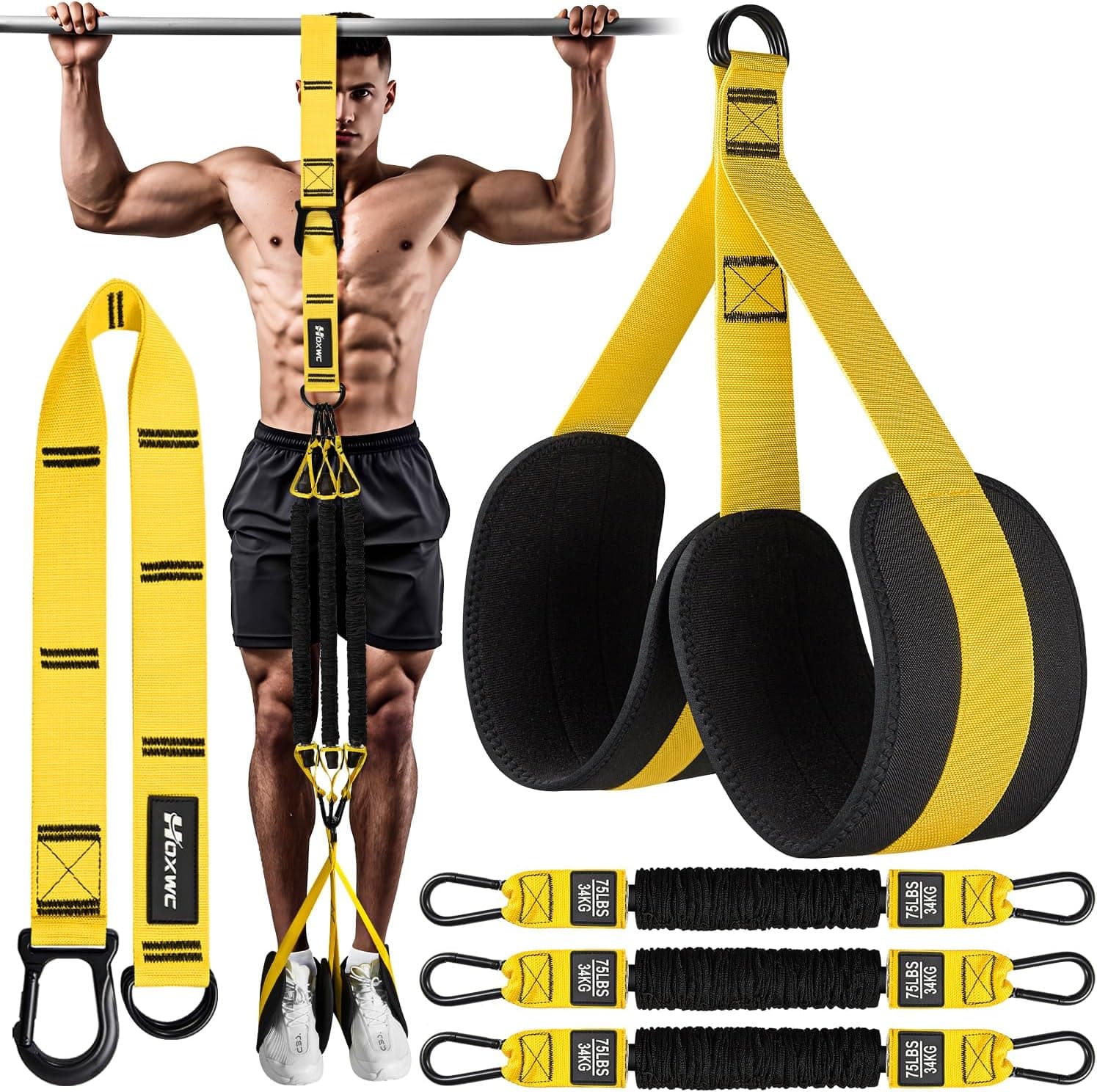
HOXWC
Pull Up Assist Mastery
Unlock a stronger upper body and core with the HOXWC Pull Up Assistance Bands. These adjustable resistance bands help you build progressive strength, making pull-ups achievable for all fitness levels. Say goodbye to plateauing and hello to consistent progress towards your fitness goals.
- Adjustable resistance levels (75-225lbs) cater to diverse fitness needs
- Comfortable double footrest design ensures stable support and correct training form
- May not be suitable for those with extremely high strength levels, as the maximum resistance is 225lbs
- Requires proper anchoring to a stable structure, which can be a challenge in some home gym setups
Comparison at a glance
Editorial Methodology
ProAthletica rankings are independently vetted by our editorial board. We analyze thousands of data points — including real customer reviews and technical specs — to give you an honest score. No brand pays for a higher ranking.
Frequently asked questions
Real answers to the questions our readers ask most. No padding, no corporate speak.
What resistance band weight should a beginner start with?
Most beginners should start with a set that includes 10–30 lbs of resistance. Light bands (10–15 lbs) work for lateral raises and rear delt work. Medium bands (20–30 lbs) cover rows, bicep curls, and glute work. Heavy bands (40–50 lbs) are for squats, deadlifts, and pressing movements. A multi-pack covering all ranges is ideal.
Read our full methodology →Latex vs synthetic rubber bands: which lasts longer?
Natural latex bands offer superior elasticity and energy return but degrade faster under UV light and heat. Synthetic rubber (TPE) lasts longer in storage and is hypoallergenic but has less snap. For heavy training, latex is preferred. Store all bands in a cool, dark place away from direct sunlight.
Are loop bands better than tube bands with handles?
Loop bands are better for lower-body work (squats, glute bridges, lateral walks) and are safer since they cannot detach from a handle. Tube bands with handles work well for upper-body pressing and pulling movements. The ideal home setup includes a set of loop bands and a separate tube band set with a door anchor.
Still have a question? Contact our team — we typically respond within 24 hours.
Free Home Gym Planner
The exact gear combos our lab recommends for every budget. Used by 4,200+ readers.
🔒 We never share your email. Ever.
As an Amazon Associate we earn from qualifying purchases · No affiliate links in emails